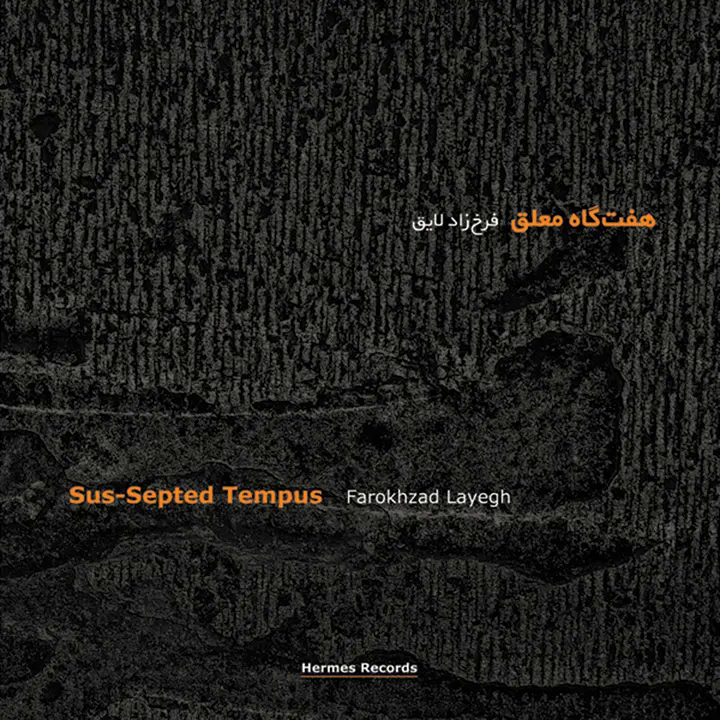
An upturned existence
Sus-Septed Tempus, or Haft Gāh-e Mua’llaq, reflects on the suspension of an upturned existence. The composer describes it as his second exploration of “volume” within Iranian modal music.
ROOM 02
Haft Gāh-e Mu’allaq
Seven movements exploring the encounter between Persian modal traditions and contemporary string writing.
Through suspension, polyphonic relationships and the transformation of musical material, the work investigates new possibilities of space, movement and expression.
Sus-Septed Tempus, or Haft Gāh-e Mua’llaq, reflects on the suspension of an upturned existence. The composer describes it as his second exploration of “volume” within Iranian modal music.
Arsalan Kamkar performs three parts; the composer, Farokhzad Layegh, performs the cello. Recorded asynchronously, these individual performances form a single string quartet.
With no singer or lyrics, the quartet continues Layegh’s search for “volume”: opening Iranian modal music towards dimensions beyond a single lyrical line. Polyphony, contrasting colours and bowed-string techniques become part of that exploration.
Critical listening notes trace a glimmer of light in the first Gāh, shifting colours in the second, striking changes of timbre in the fifth, repose in the sixth, and an encounter between Iranian modal music and minimalism in the seventh.
A critical listening perspective.
The critical texts also leave a question open: what is the musical “volume” Layegh seeks, and can polyphonic development move beyond a linear melodic foundation? The work invites listening without fixed preconceptions.
A question raised in the critical texts.
INTERNAVA Project — Debut Concerts
Darragh Morgan’s Internava Quartet
Sus-Septed Tempus
Amsterdam Sinfonietta/Tempus V
Perspectives on musical language, space, suspension and the transformation of Iranian modal traditions.
EDITORIAL NOTE / BASED ON SAEED YAGHOUBIAN’S LISTENING ANALYSIS
Across seven movements, the quartet shifts between unsettled modal centres, sharply contrasting textures and moments of fragile stillness. Yaghoubian’s close reading follows the work from its ambiguous opening through the solitary violin in Tempus IV and the tension of its final movement.
Saeed Yaghoubian / Commentary on Haft Gāh-e Mu’allaq · 2012
EDITORIAL NOTE / INDEPENDENT CRITICISM
Mohsen Saqafi discusses the work’s polyphonic writing, string techniques and Iranian modal foundations. His assessment also questions whether these devices fully achieve the composer’s stated ambition of moving from lyrical line toward musical volume.
Mohsen Saqafi / Ta’liq dar Hajm ya Edde’ayi Vahn-Bonyad? / Gozaresh-e Musiqi, no. 52; excerpts discussed by Harmony Talk (2013)
EDITORIAL NOTE / INDEPENDENT CRITICISM
Milad Kamyabian considers Layegh’s work within a broader debate about the modernization of Iranian music. His essay examines the perceived dominance of lyrical poetry and the move from the vocal setting of The Book of Austerity toward an instrumental work without words.
Milad Kamyabian / “Sedāhā-ye Nāsuti” / Etemad, 6 December 2012
EDITORIAL NOTE / SAEED YAGHOUBIAN
An avant-garde rethinking of Iranian modal music—less concerned with abandoning its foundations than with opening them toward new structures, textures and expressive states.
EDITORIAL NOTE / SAEED YAGHOUBIAN
In Tempus IV, the melancholy of Dashti is experienced through astonishment, fear and solitude—the first violin alone within a surrounding world that accompanies it, yet remains distant.
EDITORIAL NOTE / SAEED YAGHOUBIAN
Sus-Septed Tempus attempts to give musical language to suspension, fragmentation and falling.
CRITICAL RESPONSE / EDITORIAL RENDERING
A distinctive and unparalleled work.
CRITICAL RESPONSE / EDITORIAL RENDERING
Layegh’s second work should be seen as the advancement of his project.
CRITICAL RESPONSE / EDITORIAL RENDERING
Seven unfamiliar pieces … seven pure instrumental realms.
“…The composer’s approach and the final product before us, Haft Gāh-e Mua’llaq, clearly indicate that we are undoubtedly facing an avant-garde movement. Dr. Layegh’s experimental music is tradition-breaking and pioneering. We can identify all the factors that prominent art theorists like Peter Bürger have outlined regarding the elements necessary for avant-garde music in Farrokhzad Layegh’s work. For example, from Bürger’s perspective, the avant-garde artist maintains a significant distance from their cultural, social, and artistic environment. They are critical of the social conditions of their time. They criticize, and negate, and even if they cannot prove it themselves, their work shapes the art of the future. They question the currently prevalent art and take a different path. Pierre Boulez also believes that avant-garde music represents an innovation in structure and form (something that is entirely evident in Haft Gāh-e Mua’llaq). Additionally, the uncertainty of notation, the undetermined nature of form, and the freedom of choice (both in composition and performance) define the characteristics of this music. Considering these specifications, Haft Gāh-e Mua’llaq is considered an avant-garde work in the realm of Iranian music… The final point is that beyond all these analyses—whether regarding the written characteristics of the work or the impact of the creator’s unique approach on the trend of serious music in society—the most important point for me is that Haft Gāh-e Mua’llaq is a translation of the atmosphere of today’s Iranian society. In such a context, one can claim that the artist is completely honest with their audience and, moreover, strives to speak the truth and avoids imagination and lies. Haft Gāh-e Mua’llaq attempts to express the taste of suspension, disintegration, and the fall of such a society in the language of music. It tries to choose another path to escape the frameworks that have imprisoned the mind of the artist in such a society.”
“…Haft Gāh-e Mua’llaq is undoubtedly a distinctive and unparalleled work in today’s music. A work whose absence was felt and its occurrence was expected. A work full of numerous techniques, none of which were written for show, and all of which are completely and honestly in the service of music. Additionally, the composer’s good understanding of the structure and techniques of bowed string instruments, the possibilities of the string quartet, Iranian modal music, 20th-century music, and its various schools has turned Haft Gāh-e Mua’llaq into a pure polystylistic piece. In other words, it can be said that Layegh has introduced many shortcomings into Iranian music at once and succeeded in creating a work that is very fresh even for our saturated ears today.
The first Gāh begins with a glimmer of light from the darkness. Harmonics and pizzicatos beautifully combine, creating a cold and beautiful beginning that continues with the warm monologue of the cello. The Iranian audience undoubtedly quickly becomes familiar with everything, and the musical space becomes a recognized one in the depths of their knowledge and memories. Layegh introduces his space to the audience in five minutes and leaves nothing lacking.
The second Gāh clarifies the path that the audience will take through these seven Gāhs. From here on, immerse yourself comfortably, become suspended. From here on, every measure of the work creates a new color.
The fifth Gāh is one of the highlights of this work. Less than thirty seconds into this Gāh, I think to myself that if I hear Björk’s voice right now, it wouldn’t be strange. It doesn’t take long before playing the guitar in the style of Jimi Hendrix blows my mind. It’s nothing special, just the same string, the same bow. The sixth Gāh is peace of mind. The pure sincerity of the creator of these seven Gāhs.
The seventh Gāh is Iranian minimalism. If I have become a bit emotional in recent lines, I undoubtedly had no choice. The seventh Gāh brought tears to my eyes. Layegh’s mastery of American minimalism also shows itself. The eloquence and creativity that we know from Glass and Nyman beautifully find their way into modal music…”
“Iranian music, like other aspects of Iranian culture, from the moment it encountered the concept of modernity in the mid-last century AH, inevitably engaged in self-reflection. What had previously been considered natural within the existing cultural context—internal and external relations, functions, positions, and rituals—after confronting the gaze of the other—modernity—was forced to look at its reflection in those foreign eyes and thus suddenly find itself as ‘tradition.’
In such conditions, everything that was previously taken for granted was questioned, and the set of accepted relations gave way to a tangled web of questions… There have been composers who have questioned the logic of instrumentation itself, that is, the production of harmonic intervals and the creation of sonic contrast: from Morteza Hannaneh with his Armoni-ye Zoj to the Hamavayan group led by Hossein Alizadeh, the monophonic nature of modal music and its historical inability to combine simultaneous sounds has always been a topic of discussion, while attempts have been made to discover and systematize the implicit polyphony within this music. Such a question, regardless of any answer given or to be given, is clearly at a deeper and more fundamental level than the mere issue of instrumentation (which was mentioned earlier)…
Among all the current formulations of the issue of Iranian music, Farrokhzad Layegh’s question seems more serious and fundamental: the issue of volume. Layegh considers the absence of volume or, in other words, dimension in Iranian music to be the result of its parasitic connection with Persian lyrical poetry, a connection in which banquet music was the servant of pleasure and the leftover of the pompous and thematic language of this poetic literary genre. This perception of Layegh gives his diagnosis double importance: decades earlier, Nima Yushij—the same poet who, ironically, every truly innovative figure in Iranian music, to avoid remaining parasitic to poetry, finds themselves compelled to follow his example—in letters collected and published after his death under the title Harfha-ye Hamsayeh, repeatedly refers to the need to free Persian poetry from the constraints of accustomed and addicted music… It is meaningful that more than half a century later, the contemporary effort of another artist, a composer, is also focused on eliminating the restrictive connection between classical poetry and traditional music, albeit from another angle.
Layegh, in his first work, Sefer-e Osrat, without resorting to the easy ways of filling an album (stuffing a couple of ‘saz o avaz’ between a few trivial ‘tasnif’s and ending the matter with a ‘chahar mezrab’ or ‘reng’), on one hand, selects poems by Mehdi Akhavan Sales, Shafiei Kadkani, and Houshang Ebtehaj that have social—and not lyrical—themes and occasions, and on the other hand, tries to summon musical volume by producing a homogeneous texture of different colors and frequencies, and of course, only using the usual instruments of modal music. That is why even when the singer is performing an avaz with free meter, the instrument or instruments do not act merely as a sonic reflection of him, following and imitating him, but sometimes create a background for his words and sometimes come to the foreground themselves. Farrokhzad Layegh’s recent work, Haft Gāh-e Mua’llaq, is his second response to the issue of volume in modal music. The instrumentation of this second work is entirely Western: string quartet. Naturally, there is no trace of a singer or lyrics, even of the social/protest/critical type, yet it clearly demonstrates the advancement of Layegh’s project and can, that is, has the capacity and potential to provide a starting point for serious criticism of this musical tradition. For this, however, the importance of his new work—that double importance mentioned earlier—must be explained through renewed attention to the relationship between poetry and traditional Iranian music…
Placing Layegh’s remarks, in his recent interview with Etemad newspaper, alongside Nima Yushij’s Harfha-ye Hamsayeh, and reading these two formulations simultaneously provides a clear picture of the mutual issue of poetry and music… To open up Iranian music to other dimensions of existence, the result and formal manifestation of which will be the emergence of ‘volume’ in music, first and foremost, its dependence on the single dimension of lyricism in classical poetry must be eliminated, just as pursuing the same logic by Nima Yushij led to the production of new forms and, consequently, new themes in Persian poetry. But this is not enough. As far as music is concerned, it makes no difference whether we load the music with the words of Rahi Mo’ayyeri or the poetry of Akhavan, it doesn’t matter whether we burden the music with Saadi’s love avaz or Ferdowsi’s epic cry; the result is the same: both prevent music from becoming pure, from thinking about itself—the self-reflection of modern art. That is why, as I said earlier, Layegh’s second work should be seen as the advancement of his project, in which there is no trace of words or linguistic semantic reference. The importance of this point becomes more apparent when we remember that our tradition, in the broad sense, has been and is word-centric… and precisely for this reason, the most radical possible critique of this tradition is to question that primordial word, that founding word, whose substitute and representative in traditional Iranian music must be recognized as the dominant voice of the singer: towards the secularization of Iranian music.”
“Haft Gāh-e Mua’llaq is, more than anything, seven unfamiliar pieces, seven unconventional sounds, and seven pure instrumental realms, seven non-repetitive mentalities arising from the mind of a contemporary composer. The passion and intellect of the wandering Radif on the surface and depth of these suspended Gāhs have made the literature of the work unique. The corners do not want to present themselves fully; they nudge, go, come, and make the world of this work ecstatic. But the ultimate ecstasy belongs to the listener. These seven Gāhs are more of an unfamiliar music and a new experience in listening for the audience than an instantaneous or gradual experience for the author… Haft Gāh-e Mua’llaq should be heard without any preconceptions, even without the author and his words!”
“(This work) is truly a turning point in compositions combining non-native instruments based on Iranian music. Haft Gāh-e Mua’llaq is an effort in the direction of polyphonic thinking in Iranian music that has added a new page to the aesthetics of Iranian modal music. A collection full of beauty accompanied by a nostalgic feeling for those familiar with classical Iranian music. It is an experience in the wake of Alizadeh’s Ney Nava and Kalhor’s Shahr-e Khamush.
The collection Haft Gāh-e Mua’llaq is another experience in presenting a solution for the emergence of polyphonic capabilities in Iranian music. The beauty of the melodies along with accompaniments derived from the main lines of Iranian modes but with contemporary thinking, although in some cases crude and primitive. Layegh, in this collection written for string quartet, has based his work on Iranian musical modes and, by using instrumental techniques less commonly used in Iranian music, has given his compositions a remarkable color and flavor. He has combined Iranian musical melodies with various colorings known from bowed instruments and, with a kind of polyphony derived from the materials present in the structure of each mode, has given the desired composition a strange but acceptable and plausible color and scent.
Among the notable features of his compositional style are sudden modulations, successive imitations, and the use of basso ostinatos based on the main melodies of the respective mode. In general, his method of modulation involves using common notes as pedals and immediate changes of notes specific to each mode. A prime example of this is the first Gāh, where the note B natural serves as the main base and the note E flat as the secondary fixed note, playing the role of identity for the Chahargah mode, and the note F sharp acts as the modal variable. In the modulation in the middle of the piece, there is a brief passage based on the ‘Bal-e Kabutar’ of the Mahur G mode, and then with a short glissando, it returns to a degree of the Chahargah mode that lacks modal stability. Or in the sixth Gāh, where there is a modulation from Dashti to Esfahan. Another interesting point in this collection is the beginning of the next Gāh using the sonic materials of the previous Gāh, and almost always revolving around the note B natural in different registers. The use of effect techniques has become a good tool for Layegh to reduce the monotony of the collection by creating and processing rhythmic movements in the middle pieces and to encourage the audience to listen to the rest of the works. All the above points are the highlights of this work that can have a historical impact alongside Ney Nava and Shahr-e Khamush… But the issue becomes complicated when the composer makes a very big claim: freeing Iranian music from the line of lyricism and moving towards volume. Expressing anger, pain, regret, cry, anxiety, and eternal liberation. Denying the sorrow of separation, the eagerness for union, and the repeated description of love… What exactly is the volume that Layegh intends? Distancing from the lyrical narrative of classical Iranian literature? Isn’t it the case that the sentences of the Radif are formed based on this very linguistic structure, its prosodic and rhythmic weights? Isn’t the composer’s choice of Radif sentences based on this very understanding and reception of classical literature? What concepts do the further dimension and the linear single-dimensionality encompass in his view? Aren’t the sentences that Layegh has developed and expanded with imitation techniques and polyphonic imitations based on the same linear melodic movement that the composer claims to transcend?…”