FROM KIAWASCH SAHEBNASSAGH’S ESSAY
The music carried me into an intimate, mist-filled space—beautifully structured, with colours, stillness and movement succeeding one another; its many layers both novel and remarkably concise.
ROOM 03
Sefr-e Osrat
An exploration of Iranian musical traditions, contemporary Persian poetry and new relationships between sound, volume and space.
Created in collaboration with Shahram Nazeri, the work investigates possibilities beyond the conventional relationship between vocal expression, poetry and instrumental accompaniment.
The lyrical–mystical imagination has bestowed extraordinary beauty upon Persian poetry and music. Yet its predominance has also fostered a certain unidimensionality, at times veiling the violence of history and the contradictions of human existence beneath the consolations of transcendence.
Volume is conceived as a multidimensional conceptual space, where this inheritance encounters the tragic, the ambiguous and the unresolved—not to negate its beauty, but to explore what lies beyond its familiar horizons.
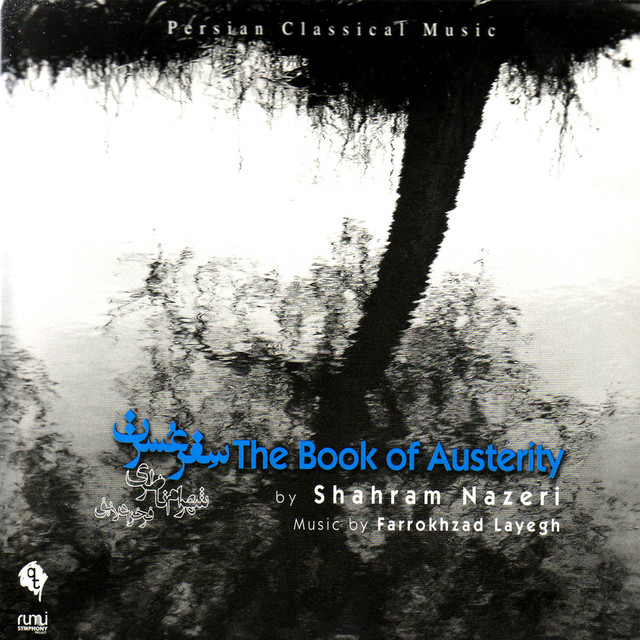
Conceived at the turn of the millennium and recorded with Shahram Nazeri, The Book of Austerity was Farokhzad Layegh’s first major attempt to open Iranian modal music toward what he describes as “volume and space.”
Setting socially engaged modern Persian poetry by Mehdi Akhavan Sales, Mohammad-Reza Shafiei Kadkani and Houshang Ebtehaj, the work moves beyond the predominantly lyrical relationship between Persian classical music and poetry, searching instead for a musical language capable of inhabiting the shifting psychological and social space of modern verse.

The work was conceived and recorded with Shahram Nazeri, whose voice becomes an integral part of its attempt to reshape the relationship between contemporary Persian poetry and Iranian classical music.
Rather than drawing on the predominantly lyrical poetry historically associated with Iranian classical music, The Book of Austerity turns toward modern Persian poetry shaped by social experience, uncertainty and historical consciousness.
The phrasing and dramatic progression of the poems inform the interplay between Nazeri’s voice and the instrumental writing, shaping changes of rhythm, texture and musical atmosphere.
LINEVOLUME
LYRICISMMULTIPLICITY
CLASSICAL POETRYMODERN POETRY
Layegh describes The Book of Austerity as his first experiment in bringing “volume and space” into Iranian modal music.
The point of departure was a perceived tension between the essentially linear, lyrical inheritance of classical Persian poetry and the fragmented, multidimensional world of modern verse.
Rather than simply setting contemporary poems within an inherited musical language, the work asks whether that language itself must change in order to inhabit them.
KIAWASCH SAHEBNASSAGH
FROM KIAWASCH SAHEBNASSAGH’S ESSAY
The music carried me into an intimate, mist-filled space—beautifully structured, with colours, stillness and movement succeeding one another; its many layers both novel and remarkably concise.
FROM KIAWASCH SAHEBNASSAGH’S ESSAY
Layegh enters this field of experimentation with remarkable intelligence, bringing Iranian modal music into dialogue with structural innovation, new approaches to timbre and selected techniques from European music.
KIAWASCH SAHEBNASSAGH · ON DAR IN SHABHA
Here Layegh arrives at a musical space completely intertwined with the poem.
EDITORIAL NOTE / INDEPENDENT CRITICISM
Kiawasch Sahebnassagh examines how layered instrumental colours, recurring ostinato figures and changes of musical space respond to the selected poetry and Shahram Nazeri’s voice. Alongside his appreciation of the work’s structural experimentation, he suggests that a more sparing use of repeated figures and a fuller development of counterpoint could strengthen its continuity.
KIAWASCH SAHEBNASSAGH / Farhang-o-Ahang / PERSIAN-LANGUAGE ESSAY
EDITORIAL NOTE / INDEPENDENT CRITICISM
The Persian review considers how the music reshapes selected modern poems through collage-like sequencing and changes of rhythm and melody, giving the texts a different musical reading. It also identifies suspension and an unpredictable sense of continuation as central to the album’s listening experience.
TEHRAN-E EMROOZ / ISSUE 352 · 19 AUGUST 2010 / ARCHIVAL SOURCE CREDIT
READ THE ARCHIVED PERSIAN REVIEW ↗ READ THE NEWSPAPER SOURCE CREDIT ↗
The Book of Austerity
THE COMPOSER’S EXPLANATION / EDITORIAL SUMMARY
The title Sefr-e Osrat draws on layered meanings in Persian. Sefr (سِفر) is an archaic term for a book or volume, recalling the named books of the Old Testament. Its sound also evokes sefr (صفر), “zero,” with associations of absence and nothingness. Osrat (عُسرت) means hardship or austerity. As Layegh explains in a published interview, the old-fashioned vocabulary and the repeated sibilant sounds were deliberately chosen to create a severe, unfamiliar atmosphere—one that asks the listener to reflect on the work before hearing it.
BASED ON FAROKHZAD LAYEGH’S INTERVIEW WITH MAHMOUD TAVASOLIAN / ETEMAD
COMPOSER’S STATEMENTS / ARCHIVE
EDITORIAL SUMMARY / FROM THE COMPOSER’S PUBLISHED STATEMENTS
In his discussion of The Book of Austerity, Layegh approaches musical “volume” as an alternative to the single lyrical line that, in his view, has long shaped Iranian classical music. It does not simply mean adding instruments or increasing polyphony. Instead, he explores how dynamics, contrasting timbres, unexpected modal shifts and an economy of musical means can give expression to other dimensions of human experience.
Contemporary Persian poetry is central to that enquiry. Rather than setting new poetry within familiar vocal conventions, the work seeks a different relationship between language, instrumental writing and musical structure. Layegh also describes Shahram Nazeri’s openness to experimentation and their shared development of the vocal material as essential to the album’s formation.
BASED ON THE COMPOSER’S INTERVIEW WITH MAHMOUD TAVASOLIAN / ETEMAD. ENGLISH EDITORIAL SUMMARY, NOT A VERBATIM QUOTATION.
READ THE PERSIAN INTERVIEW ↗ EARLIER COMPOSER STATEMENTS ARCHIVE ↗