ABOUT
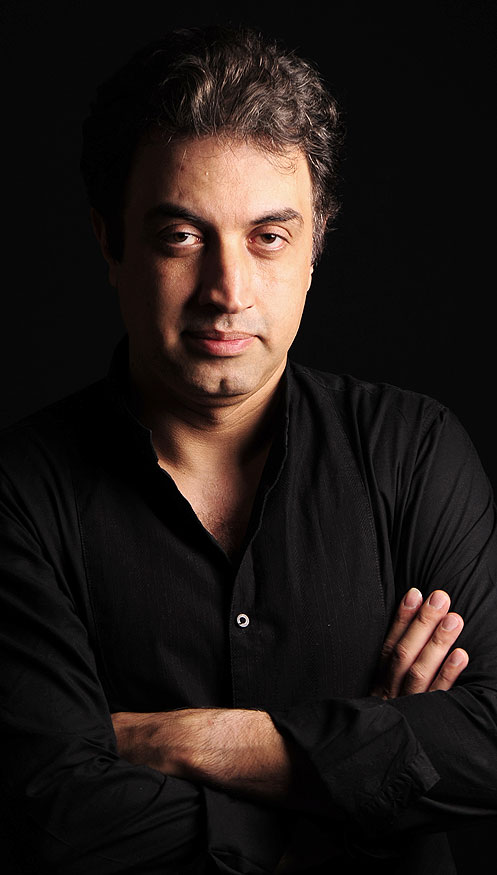
Farokhzad Layegh
Composer & Interventional Cardiologist
Two professional lives. Two radically different forms of inquiry.
01
SHORT INTRODUCTION
Farokhzad Layegh (b. 1963, Shiraz) is an Iranian composer whose music brings Persian musical heritage into dialogue with contemporary Western composition, literature and interdisciplinary performance. His work explores relationships between musical tradition, language and the possibilities of contemporary expression.
02
FORMATIVE YEARS
Layegh began studying violin at seven. Following the 1979 Revolution, when public musical life in Iran was severely restricted, he set music aside to pursue medicine. He returned to musical study years later in Paris with setar player Reza Ghassemi, subsequently studying Persian music with Massoud Shaari and drawing on the teaching and perspectives of Hossein Alizadeh and Dariush Talai.
03
TWO PROFESSIONAL LIVES
Alongside composition, Layegh maintains a career as a senior interventional cardiologist. His musical and medical careers have developed independently: one engages language, memory, abstraction and meaning; the other the human body, uncertainty and intervention.
04
THREE MAJOR WORKS
The Book of Austerity (2007), recorded with Shahram Nazeri, brings contemporary Persian poetry into dialogue with a modern re-interpretation of Persian musical traditions.
Sus-Septed Tempus (2012) extends this inquiry into Western chamber music through a seven-movement cycle originally conceived for string quartet, with movements subsequently arranged for string orchestra.
Completed in 2021 and released by Hermes Records, Lexolalia Descenticum grew from a dream of T. S. Eliot reciting The Waste Land alongside the voice of Ahmad Shamlou. The imagined voices, separated by language, geography and history, confront a shared experience of cultural and existential disintegration. Its eight parts explore language, fragmentation, disconnection and renewal. Layegh performs the setar parts in The Book of Austerity and the cello parts in Sus-Septed Tempus and Lexolalia Descenticum, bringing a personal, self-taught approach to the instrument.
LEXOLALIA DESCENTICUM ↗ · SUS-SEPTED TEMPUS ↗ · THE BOOK OF AUSTERITY ↗
05
INTERNATIONAL COLLABORATIONS
Sus-Septed Tempus was performed at Cadogan Hall in 2020 through Music Without Borders, a programme of INTERNAVA, the initiative Layegh co-founded with conductor Mark Stephenson. INTERNAVA supports Iranian musicians and composers and introduces contemporary Persian music to wider audiences. String-orchestra arrangements of Sus-Septed Tempus received their Dutch premiere with Amsterdam Sinfonietta at Muziekgebouw Amsterdam in a programme featuring Kayhan Kalhor and Kian Soltani. For the Amsterdam Sinfonietta performances, Ashkan Layegh arranged Sus-Septed Tempus and Lexolalia Descenticum for larger string ensemble from their original string-quartet scores. The ensemble subsequently produced a Tempus V film directed by Hans Pannecoucke; the work also appeared in Walldance with Bencha Theater at a 2020 ceremony attended by Queen Máxima.
Layegh proposed developing Lexolalia Descenticum as an interdisciplinary performance to Amsterdam Sinfonietta. The resulting Waste Land / Het barre land was developed with ISH Dance Collective and an artistic team including Candida Thompson and Marco Gerris. Combining strings, contemporary and hip-hop dance, aerial acrobatics and theatrical imagery, it premiered in the Netherlands in 2022, returned for a national tour in 2025 and received its Asian premiere at the 53rd Hong Kong Arts Festival on 15–16 March 2025.
06
ARTISTIC OUTLOOK
Literature, philosophy, science and the visual and performing arts remain central to Layegh's artistic inquiry. Across concert music, film and interdisciplinary performance, his compositions revisit the relationships between musical inheritance, contemporary language and the spaces in which a work can unfold.
BIOGRAPHIES
SHORT BIOGRAPHY / 102 WORDS / PDF ↗